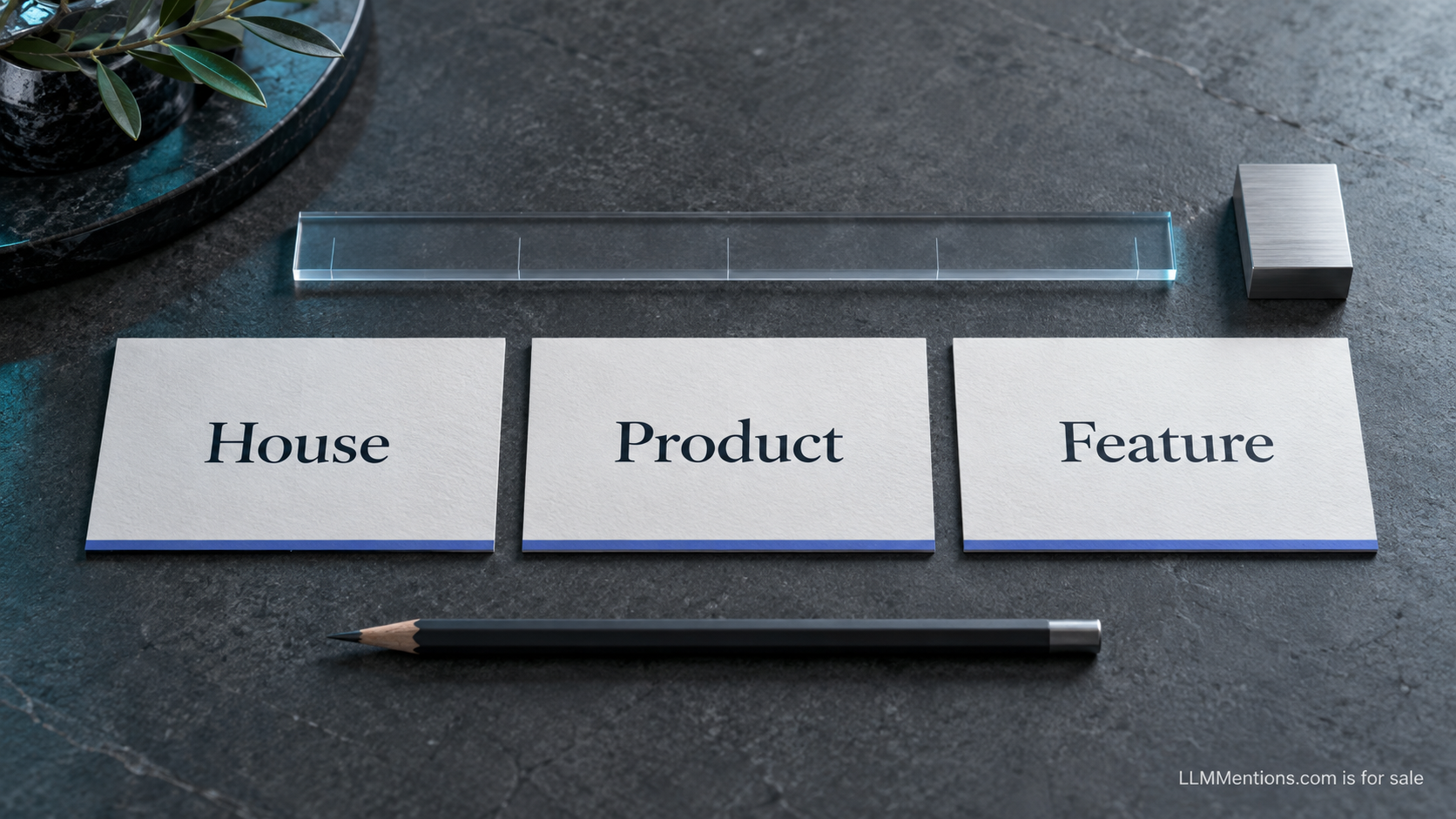
Naming an AI mentions product starts with deciding what the customer is buying. A monitoring feed, a research service and a tool for correcting public source material may serve the same department, but they make different promises. A name should help a buyer enter the right conversation before the product description fills in the detail.
Begin with the job and the business structure. Then test candidate names against ordinary use: a spoken introduction, an email subject, a report heading and a documentation page. The aim is a name that people can understand and use, with a product promise that the team can support.
LLMMentions.com is available for acquisition and provides a direct category example in this discussion. The naming framework is an editorial decision aid. It does not establish trademark clearance, predict demand or imply any relationship with an AI vendor.
Decide which level needs the name
A company name must accommodate the business beyond its first feature. A product name needs to explain a coherent offer. A feature name can be much narrower because it lives inside an existing interface and brand. Confusing these levels often leads to a long company name that describes only one button.
Write the proposed structure on one page. For example, a fictional research company might offer a mentions product containing an evidence export feature. The company, product and feature each need different amounts of explanation. A descriptive feature label may be ideal even if the company uses a distinctive invented name.
Also decide whether the product will stand alone in sales conversations. If customers will encounter it without the parent brand, its public address and introduction carry more of the explanatory work. If it is always sold as part of an established suite, the parent may already provide much of the context.
| Naming level | Main job | A useful test |
|---|---|---|
| Company | Identify the business across offers | Can it support the next credible product? |
| Product | Explain a coherent customer purchase | Does a prospect understand the subject? |
| Feature | Describe an action inside the product | Can a user predict what happens next? |
| Report | Set expectations for the evidence | Does the title match the scope of the data? |
Put the buyer’s language beside the candidate
Collect the phrases people use when describing the problem. Ask what they call an answer that names their company, what they mean by a citation and what task they expect from monitoring. Use interviews or existing customer conversations where permission allows. Avoid assuming that terminology familiar to a founder is equally familiar to every buyer.
For each candidate, write a one-sentence introduction. “A weekly record of how selected AI answers describe your product” is specific enough to test. “The future of brand intelligence” asks the reader to supply the product details. The introduction should work even before a designer creates a wordmark.
A direct category name such as LLMMentions can make the subject visible early. Its fit still depends on the audience. A technical marketer may understand LLM immediately, while a buyer outside the field may need it expanded as large language model. That is a messaging decision to test, not an objection to wave away.
Separate a category signal from a capability claim
A name can indicate the territory without promising complete coverage. Words such as “all,” “total,” “official” or “guaranteed” can create expectations that the product cannot defend. Even a relatively plain report title can mislead if the underlying sample is narrow.
Write the strongest claim implied by each candidate. If “universal monitor” suggests access to every conversation, ask whether the product can support that expectation. If “citation verifier” suggests source checking, ask whether it actually checks support or merely extracts URLs. The exercise often reveals a product-positioning issue before it becomes a naming issue.
NIST’s Generative AI Profile provides context for treating generated claims with care. A product operating around those claims should be equally careful about its own labels. A name and tagline should not imply certainty that the evidence model does not provide.
Test the name in five ordinary places
Say it aloud in a short introduction and ask someone to write it down. Put it in a plain email subject without a logo. Place it above a sample report. Add it to a documentation heading. Finally, imagine a customer mentioning it to a colleague who has not seen the product.
These tests reveal different problems. A name may look elegant but be difficult to spell after hearing it. A clever phrase may work in a campaign but look vague on an invoice. A highly technical abbreviation may fit developer documentation while requiring more explanation in a procurement conversation.
Use a small, relevant group for qualitative feedback and avoid turning informal preferences into a false market statistic. Ask what people think the product does, which words they remember and what they would type to find it. Record the answers before explaining the intended meaning so the test measures the first impression.
Compare candidates with a written matrix
A simple matrix can include subject clarity, spoken usability, spelling, audience familiarity, expansion room and claim accuracy. Give each criterion a short explanation. The score matters less than the reason behind it; a candidate with a lower total may fit better if it performs well on the job that matters most.
Include a disqualifier column. A likely conflict, an unintended meaning in a priority market or a capability promise the product cannot support may outweigh several positive traits. Do not average a serious unresolved concern away because the visual design is attractive.
For the domain decision, consider how the exact address will be used in introductions, links and account communication. Ownership of an address is distinct from the right to use a mark in a particular market. The USPTO’s guidance on comprehensive clearance searches explains why a broader review matters. Specific clearance decisions belong with qualified trademark counsel.
Check the next credible expansion
Describe the first offer, then one plausible adjacent offer. A mentions monitor might later add source review or evidence exports. Ask whether the proposed product name can accommodate that move without misleading the original buyer. There is little value in testing imaginary expansions unrelated to the team’s actual direction.
A broad company name and a descriptive product name can work together. So can a direct category domain for a focused business. The choice depends on the architecture and intended audience. Resist adding more abstractions simply because the company might someday do something else.
Keep vendor names out of the core identity unless the team has a sound basis and appropriate rights for that use. A product can explain which interfaces it supports in its documentation. The brand itself need not imply a partnership or endorsement to make that support understandable.
Rewrite the promise before committing
Take one vague claim and replace it with an observable task. “Own AI discovery” might become “Review saved answers to a defined set of buyer questions.” “Know what every model thinks” might become “Compare how selected surfaces describe your product.” The narrower wording gives both sales and product a claim they can discuss concretely.
Then test whether the candidate name still fits. If it only feels compelling beside an exaggerated promise, it may be carrying the wrong expectation. A strong name should remain useful next to a careful explanation of the actual service.
The next step is to produce a short naming sheet: business level, target reader, customer job, three candidates, their strongest implied claims and the unresolved checks. Use that sheet for product, design and professional clearance conversations. If LLMMentions.com fits the intended direction, an inquiry can explain the product shape and the team’s acquisition interest without treating the domain itself as proof of business success.